



















The only practice strategy you’ll ever need
As a flute teacher, I have often seen my students make things unnecessarily hard on themselves and use ineffective strategies for their flute practice. This frequently leads to frustration, stagnation and sometimes even feeling like they want to give up on the flute altogether. In this blog post, I share my favorite, core practice strategy. It can help you approach any music you want to play. And since I’ve seen it work so many times, I simply can’t keep it to myself! 😉
My dear flutist, does this sound familiar? You’d like to learn a piece of music and, to do so, you play it over and over and over. You’re hoping the repetition factor will help you to improve. In most cases, it does not. This causes frustration and discouragement and has you thinking: What am I doing wrong!?
Deepen your learning and watch the video version of this blog with me demonstrating this principle as I go!
Break it down or slow it down!
Here’s the thing. When approaching any piece of music, or even scale or arpeggio, the best way to go about that is to approach it mindfully and with clear intention. If you want to see measurable change, you need to have a targeted approach. I have a simple sentence I use with students that encapsulates this perfectly. I tell them: Break it down or slow it down!
What does that mean?
So, let’s dive into this practice hack. What do I mean by it? For example, let’s say you are playing a piece of music and you get to a place in the music that’s just not working. It doesn’t sound right and you’re making a lot of mistakes. In this situation, you have one of two options: Either you can slow it down, or break it down.
If you chose the first option, you’re playing the piece considerably slower than it should be played. If you break it down, you’re zooming in on smaller, shorter chunks of music at once, instead of focusing on the whole piece.
Why does it work?
Here’s why it works. Your brain is a supercomputer, capable of achieving amazing things. Yet its processing power – much like a real computer – is limited to a certain speed and memory. When you start overloading it, it can freeze up and maybe even shut down. This is not what you want to happen. You want your brain to process and absorb the information it’s receiving in the best possible way.
Often this is the problem when we first approach a new piece we’re trying to learn. Sometimes we can feel overwhelmed just by looking at it! So many runs, such a fast pace – how will we ever conquer it? When this happens, breaking it down or slowing it down is the best thing you can do! And, this technique is not just for pieces – you can apply it to anything you want to play – be it a piece, technical exercise, or even a scale.
In fact, it’s a bit of a mathematical formula. For those who hate math, bear with me, it will make sense in a moment. If you slow it down, it becomes easier and if you break it down it also becomes easier.
This means:
Difficulty of a section = The speed of the section X The length of the section
So, the higher the speed and length of the section you are playing the more difficult the section will be. But, by lowering one or both of these parameters, whatever you are playing becomes a lot easier very quickly!
How can I apply this strategy?
When you first decide to play a new piece of music, especially if it looks overwhelming, slowing it down might be a good place to start. Seriously! It’s as simple as just playing it slowly. However, many will soon realize that this too is overwhelming and you are going to want to break it down into smaller chunks as well. Remember, your brain can only hold onto a small bit of new information at a time. The piece of music will feel more manageable to play this way, and can also help you identify the problem areas. Once you’ve pinpointed those, you can also start implementing this strategy in a whole new way.
You will start by honing in on just those tricky passages and specifically target those parts in the music that are challenging to you. This could be just one or two bars or even one or two notes in the music that you keep stumbling over.
Now you will be able to change the speed as needed. If you play the section and realize you are not managing to play it accurately and with a sense of ease, you will want to lower the speed. If you feel you are managing it you can gradually increase the speed.
The real magic of this method though, is that by playing smaller and smaller sections you can add more speed. This allows your fingers to get used to playing at speed without overwhelming your brain.
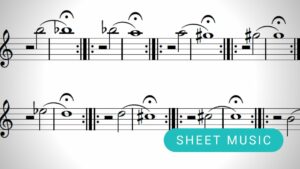
For example, let’s look at this wonderful study by Köhler. I have broken down my practice and decided to play just this measure.
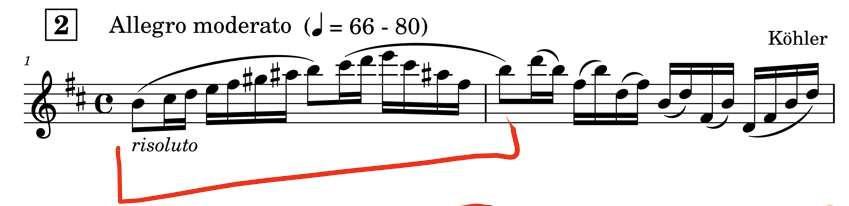
I play this measure at 50 bpm but it’s still not clean
Now, I realize the real issue is in the second half of the measure so I break it down further.
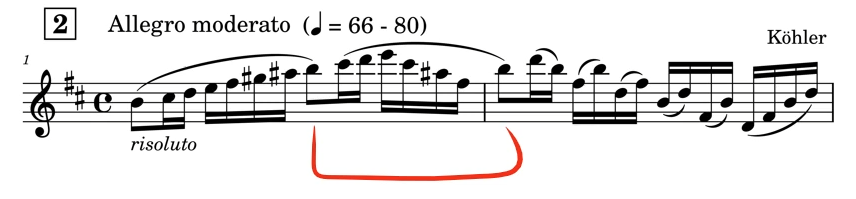
By just playing this smaller chunk, I find I can manage it at 50 bmp or even faster. My brain does not have as much to think about.
Let’s take this example a step further. Imagine I still struggled with this section. I now zoom in even more and discover the exact cause of my problem. It’s the transition from the C# to the A# to the F#.
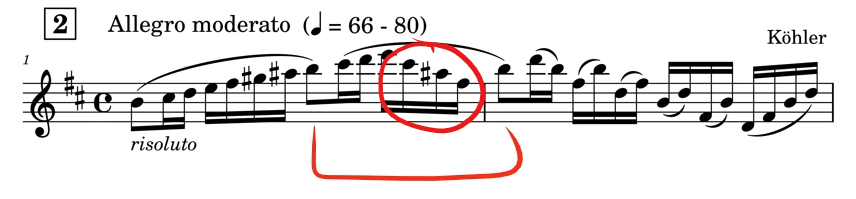
Now I can practice this combination of notes, usually getting them a lot faster quite quickly and then start zooming out and putting them back into context.
By applying this simple strategy, you will, eventually, be able to play them well and at the right speed.
While it’s usually good to apply both parts of this strategy to any piece of music you’re learning, there are times when you might prefer one over the other. Let me explain…
Specific uses of slowing it down or breaking it down
While both slowing it down and breaking it down will help when you’re trying to tackle a piece of music strategically, you can employ them individually for specific uses as well.
Slowing it down might be useful when you are playing a larger chunk of music and are trying to sew a piece together. For example, if you practiced the first and second line of the Köhler study below separately and mastered each of them on their own but now wanted to put those two lines together, you would want to play them through slightly slower than you have been practicing them to ensure you practice then accurately.
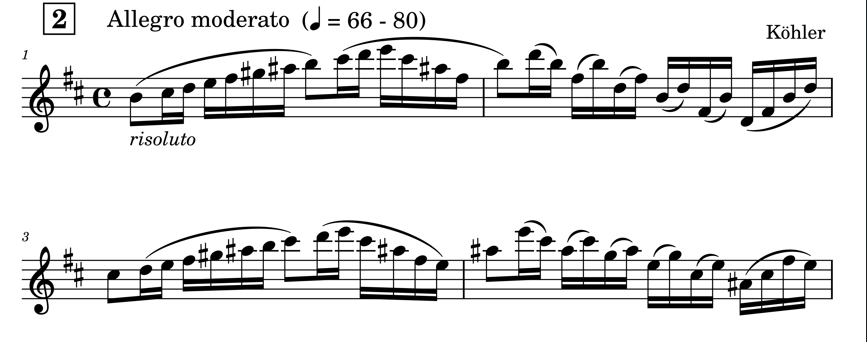
However, if you’re working on maintaining the right speed, particularly if it’s a fast piece, breaking it down will work well. So you’ll be practicing in many bite size pieces, but still be playing those pieces at full speed. This works particularly well for double-tonguing (for those who have already got there!) as it often does not make sense to practice double-tonguing very slowly.
It’s always important to remember to balance those two things – speed and accuracy. If you find that the piece of music you are trying to play is especially challenging, then you might want to employ both parts of this practice strategy: Break it down AND slow it down!
How do I know that it’s working?
While this way of practicing might not sound appealing at first glance, I encourage you to stick with it! It might not work overnight or even seem like you’re moving forward, but as you press on, you’ll slowly start seeing improvements.
So what could these improvements look like? Well, one very practical gauge might be this: Can you play that tricky part in the piece three times in a row without messing it up? My flute teacher used to say – three times in a row and you’re good to go! The first two times might just be luck or coincidence, so try three times in a row. If you can do that, you’re ready to move on to the next tricky part.
I live by the words of Marcel Moyse in my practice: It is a matter of time, patience and intelligent work. The method I’ve outlined to you here is a very intelligent way to practice, however, it needs patience and for you to do this consistently over time.
Lastly, if you haven’t already heard of it, our latest brainchild, an intensive flute learning program called Let’s Practice, Together! uses the very method I am describing to you here. I take you through every piece, exercise and scale and walk you through it, step by step. So yes, I break it down, slow it down, and teach you everything you need to know in a methodical and targeted manner. If this appeals to you and you’re interested to know more, click on the button below.
Some last words of encouragement
If you’ve been guilty of playing through pieces over and over, as I was describing, it’s never too late to change your practice strategy.
And as you start using this strategy, you might also be asking yourself: How slow is slow? My answer: As slow as you need! Your brain needs time to process the notes you are playing, so if that means four times as slow as you’re supposed to play it, then so be it! It might even feel like you’re not doing enough at first, but trust me, the consistent, dedicated effort you put in will eventually pay off. In the end, you’ll learn what you’re trying to play faster than ever. 👏
Lastly, one of our community members created this beautiful poster illustrating the Slow it down, Break it down practice strategy. Isn’t it great? I like it so much that I am placing a link to her shop down below (this doesn’t benefit me in any way, I just really like the poster and want to support her!🥰). So if you need a reminder of this, please go ahead and purchase it at her shop by following the link below.

As always,
Happy practicing!
Tatiana






Responses