









Contrary to popular belief, scales don’t have to be difficult to learn or play. When approached correctly, scales can become an effective and powerful part of any flutist’s practice routine.
To make things a little easier for you, I’ve come up with five steps that will help you learn your scales faster and with more confidence. Let’s get started!
Step 1: Understand your scales
The first and most important step in mastering your scales is to understand how scales work.
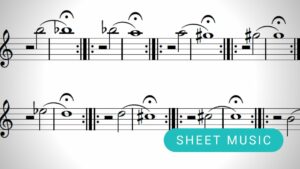
I’m talking about understanding which sharps and flats are part of a particular scale, the minor/major relative of that scale, what the raised 6ths and 7ths are in a scale, and so on.
When you understand how scales work and how they’re related, it not only makes things easier for you, but you’ll also be able to remember, recall, and play them that much more accurately.
TIP: Don’t play scales from sheet music…ever!
If you’ve done an external flute examination before, you’ll know that these often require you to play scales almost on command. Being able to do this takes quite a lot of skill and knowledge but is so valuable. There is so much power in understanding your scales, as opposed to just reading the notes from a page.
Perhaps I am being a little dramatic when I say ever. But honestly, when students just understand and learn the scale without even thinking about sheet music, they tend to learn them the quickest. That being said, I write out scales for students all the time. I don’t love it, but it is a way to help students at least understand scales.
So, yes, you can start with sheet music but try to get away from it as quickly as possible!
Step 2: Silent rehearsal
Another way to train your brain when it comes to remembering a scale is to sit with your flute and press down on the keys silently. As you do this, say the names of the notes out loud. You can do this without your flute too. Doing this kind of brain training over and over will help the notes to sink in and eventually go into your long-term memory, which is what you want.
I have a student who has even referred to this technique as one of my “superpowers”. She was really struggling with her scales so we sat down and went through them silently. The results were incredible!
Step 3: Stop and think before you play
This goes along with step 1. When you understand the scale you are about to play, i.e. which other scale is related to it, what raised 7ths it has, etc. it will get easier and easier to recall.
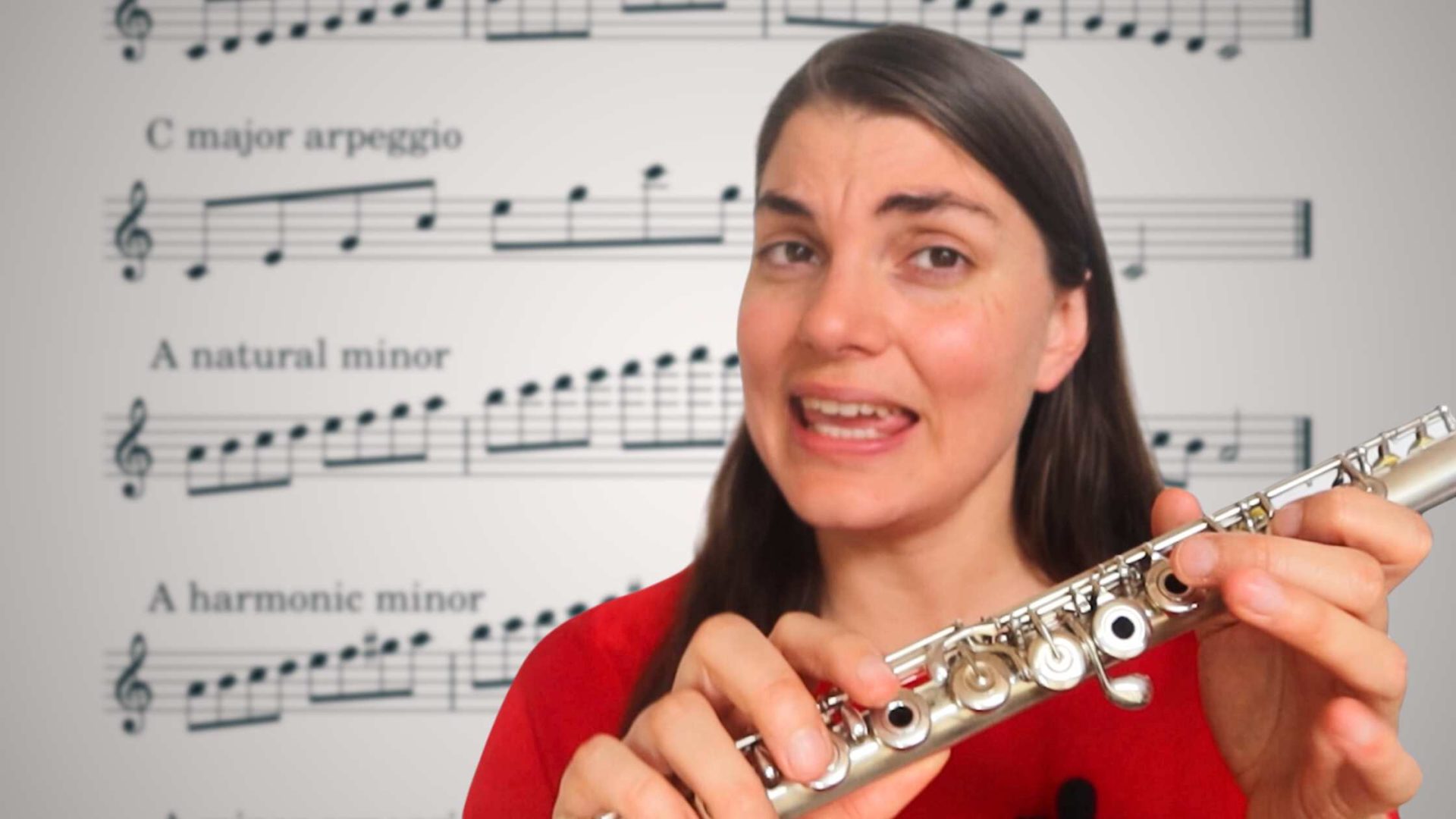
So before you start a scale, bring this information to your mind. Let me give you an example: You are about to start playing A harmonic minor and go over this information in your head: A minor is related to C major, which has no sharps or flats. However, since you are playing the harmonic minor scale, it has the raised 7th, which is G sharp. Once you are clear on what you’re playing (which comes from a good understanding of scales), it will be easier and easier to recall them on command.
Step 4: Play beautiful, musical and confident scales
When you play scales, play them beautifully and confidently! Just because a scale is not a piece, does not mean you shouldn’t play it musically and not use phrasing. The way you deliver a scale can make all the difference in how it sounds and also how it’s received. You want that scale to sound full and beautiful and show off your musicality. So go on – take a deep breath – literally and figuratively – and play that scale with confidence!
Step 5: Practicing on purpose
Once you have played your scale you get to ask yourself the all-important question: how did it go? Did you manage to play all the notes correctly? How was your tone? What could you do better?
If you are happy with the scale, fantastic! Move on to the next scale or work on something else (depending on your practice plan).
If the scale is not what you hoped it would be, it’s time to get to work. You need to identify the problem and apply the right strategy to help solve the problem. It may not be right away, but in time, if you keep at it, you will work toward improving that scale.
So how can you go about improving the scales that need work? You could practice them in different rhythms, in different articulations, or with a metronome. You could practice specific parts of the scale, or try to play it in just one octave until you get it right. The point is, don’t just play the scale again and hope that it will get better. Be purposeful about how you want to play and improve it. Need some more ideas on how to do that? Check out this blog post HERE.
Getting your scales right is bound to rub off positively on all parts of your practice. My challenge and encouragement to you is: Start approaching your scales with more confidence and purpose today!





Responses
I will admit to being confused by the minor scales. For example, D minor is the relative of F Major, which has a Bb. So if someone tells me to play a D minor scale I would just play a scale starting on D and play only with the Bb. But above you say the D minor scale will also have a raised 7th which is the C#. So I’m guessing that if I’m asked to play a D minor scale, I need to assume that I’m playing the harmonic scale with a raised 7th. And then only play the natural scale if I’m specifically asked to play Natural D minor. I have your scale book, which is absolutely amazing, but I have been confused by the “label” on the scales. In other words, the label says D minor, but looks to be assuming that D minor automatically includes the C#. Even if it is not indicated as the harmonic minor. I hope my question makes sense.
Tell me if I’m correct in assuming that when asked to play a minor scale I should play it with the raised 7th unless I’m specifically asked to play the D natural minor. Or when asked to play D melodic minor, (that I’m still trying to wrap my head around.) 😁
I agree. If asked to play a minor scale, I would default to the natural minor (Aeolian mode) of the major scale. Also, why default to the harmonic, not the melodic. But, maybe my understanding is wrong.
You can see my responses above. I think the biggest reason we do tend to default to the harmonic is that for many students learning the scales it is easier than the melodic. Usually, I teach the natural as a way of showing the relationship to the major (it’s really the easiest but a lot less common in western classical music traditions). The harmonic is the next step and a good bridge toward the melodic that is probably the most common in western classical traditions but can be tricky to understand. That being said, that particular part of the blog post should have specified harmonic minor and now does! Complete oversight!
This was exactly my confusion in reading the blog post, which I just read today. I would have assumed, if asked to play an A minor scale, you play the natural minor – no sharps or flats. But as you say, this blog post seems to indicate that if asked to play the minor scale, you actually play the harmonic minor. I’m confused as well.
Hi Jen, the minor scale has 3 types: the natural, the harmonic and the melodic. If you are asked to play a minor, you could play any of the 3. Most commonly, in the classical fields, it harmonic or melodic would probably be more common, but it would be a question I would expect a student who knows all 3 would ask: which one?
That being said, we have edited the post to be more specific! It was an oversight on our part. Thank your for you comment!
Thank you for the in-depth explanations.
Thanks, Tatiana! That clears everything up perfectly!
Very good point! I mean technically it is one of the minor scales and yes, in classical it is often the more ‘default’ scale but, the melodic and natural are just as much minor scales as well. I will amend and add the specific scale there. If I ask a student for the minor and don’t specify, they would be free to play any of them. Generally, I recommend students play the harmonic though as the natural is basically the same as the major and the melodic always feels more challenging than the harmonic. This is why we default to the harmonic in the scale exercise section of the Scale Book. In the advanced section, we actually use the melodic as well to up the challenge.
So what you’re saying is take your time before you play
Amazing information
Tatiana your information is intensely helpful.
I just received your flute book excellent so I will apply these suggestions.
your breathing course resolved my issues not finished yet and I look forward to the long tones course. many thanks
Hi Crissea! I am so delighted to hear that!!!! I hope it brings many more hours of joy!
Your commendation on practicing on purpose is called “deliberate practice” in the world of educational psychology. (This was the area of my PhD, which unfortunately I was unable to finish due to the death of my mother, but that’s another story…) Deliberate practice is critical in music. I was a professional singer and used it constantly to learn new songs and work on them until they were performance ready. You could do an entire blog on just that subject to cover all the ways to do it.