
Learning an instrument can be an incredible, life-changing experience. This can be especially true when we make this decision later in life (keep reading to find out why!).
Today, we’ll uncover some fascinating and compelling reasons why you (or someone you know!) should learn the flute, no matter how old you are.
- Physical benefits
Did you know that learning and playing the flute can have many physical benefits?
For one, it strengthens the respiratory system. Since playing the flute involves controlled breathing, it can increase lung capacity and improve breath control. This can be especially helpful for older adults.
You see, as we age, our lung function naturally declines. This means that our diaphragm weakens and lung elasticity decreases. Playing the flute counters this by encouraging deep breathing and full lung expansion. (Pretty cool, huh?)
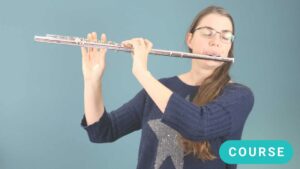
Playing the flute also promotes body awareness and teaches us to stand and sit better. Any good flute teacher will understand the huge impact that your body has on your playing. How you stand (or sit) impacts your breathing, your fingers, your tone and so much more! That’s why learning to use your body in an aligned and balanced way is critical to playing the flute. The wonderful thing is that this can be transferred to other parts of your life too. As you learn to move your body better in flute playing, you will become more aware of it and start to stand and sit better in your daily life.
Lastly, playing the flute also helps sharpen fine motor skills. It strengthens hand-eye coordination and improves dexterity—not just in your fingers, but also in your tongue, lips, jaw, and a whole range of abdominal muscles. These movements require precise control and coordination.
- Cognitive boost
Along with all the physical benefits, playing the flute also has a huge impact on your brain.
Playing the flute supports neuroplasticity, the brain’s ability to adapt, reorganize, and form new connections. By playing a single note, for example, your brain reads the music on the page and interprets it, then your body coordinates the muscles to produce the tone. Meanwhile, you are listening to the sound, allowing your brain to analyze the tone to determine its quality and pitch before the body makes any necessary adjustments. And that is just one note!
In other words, playing music engages multiple parts of your brain. These include reading, interpretation, coordination, concentration, analysis, listening, memory and emotional expression!
As you can see, playing the flute is quite the workout for the brain. This is particularly significant because many of these skills tend to decline with age. However, playing a musical instrument can help slow that process. Several studies have found a link between musical activity in older adults and a reduced risk of cognitive decline (Arafa et al., 2022). That alone should be a great reason to play an instrument!
- Breathing to destress
We’ve already mentioned how breathing on the flute can strengthen your respiratory system. But did you know that breathing on the flute can also be a way to destress? Let me explain…
When you breathe on the flute and exhale in a slow and purposeful way, your body naturally shifts from “fight or flight” mode into a more relaxed state. This means you are actually calming your nervous system just by breathing as you play the flute!
When we are stressed, we often take very shallow breaths that feel like they are coming from higher up in our chest. Since playing the flute encourages deeper breathing, we reduce tension in our bodies and minds this way.
In fact, it’s almost impossible to play the flute well while you’re tense or rushed. Playing the flute teaches you to slow down, breathe deeply and find ease in each phrase.
- The satisfaction of following your dreams
There is some interesting data out there to suggest that people who pursue their goals and dreams have a greater sense of meaning, well-being, and are generally happier with their lives.
Fulfilling a long-lost dream can help you reconnect with parts of yourself that you may have lost or set aside. Often, we become so closely tied to the roles we’ve taken on—like a job title or a family role—that we forget there’s more to who we are.
Playing an instrument can help you untangle yourself from those labels. It reminds you that, beyond your responsibilities, you are also a creative and expressive individual. This rediscovery can strengthen your sense of self-worth and bring a deep sense of personal fulfillment.
I have watched this scenario play out in countless community members’ lives and witnessed so many gain a deep sense of satisfaction from playing the flute. I have also seen students go on to fulfil other dreams through their newfound confidence, such as completing a novel, joining a band or orchestra, being brave enough to play in church and even taking on paying gigs!
- Improved mental health
The famous poet and thinker, Victor Hugo, famously said: “Music expresses that which cannot be said and on which it is impossible to be silent.”
Throughout my years of teaching, I have seen how deeply powerful music can be in helping students deal with the challenges of life. When I was 18, we got the shocking news that my dad had cancer. If any of you have ever experienced those harrowing moments between the initial diagnosis and learning how severe the cancer is, you will understand the state of mind I was in. I remember taking out my flute and playing Bach. The numbness and shock dissolved into tears just streaming down my face as I played. Thankfully, my dad’s prognosis was good and 17 years later, he is still with us! But it is experiences like this that have led me to believe that music is naturally therapeutic.
Apart from the body awareness, deep breathing and sense of fulfilment and satisfaction that all contribute to improved mental health in their own right, playing the flute also offers an emotional release that calms the nervous system.
In fact, a 2016 study by Kaimal, Ray, & Muniz found that 45 minutes of creative activity (art sessions in this case) reduced the stress hormone cortisol significantly and studies done using music have yielded similar results (see references below for some more reading on this).
Playing music every day is a way to express yourself in a lyrical, expressive and deeply personal way, helping you work through difficulties, express deep emotions and become more mentally grounded.
Become a lifelong learner!
When you play the flute, you’re essentially signing up to be a lifelong learner!
You see, you’re never really “done” with learning the flute – there’s always a new piece to master, a technique to improve, or a new style of music to explore. And this constant progression fosters a mindset of lifelong learning. It means you’re growing in patience, keeping your curiosity alive and constantly growing as a person.
Learning the flute doesn’t just mean you learn to play the instrument, it also teaches you how to learn. And that skill can often also spill over into many other areas of your life.
Ready to start this adventure, or know someone who does? Click on the link below to find out more about learning programs. We have several levels available, including our latest beginner course, which will provide you with some great help getting started on this wonderful instrument called the flute.
References:
Arafa, A., Teramoto, M., Maeda, S., Sakai, Y., Nosaka, S., Gao, Q., Kawachi, H., Kashima, R., Matsumoto, C., & Kokubo, Y. (2022). Playing a musical instrument and the risk of dementia among older adults: A systematic review and meta-analysis of prospective cohort studies. BMC Neurology, 22, Article 395. https://doi.org/10.1186/s12883-022-02902-z
Grebosz-Haring, K., & Thun-Hohenstein, L. (2018). Effects of group singing versus group music listening on hospitalized children and adolescents with mental disorders: A pilot study. Heliyon, 4(12), e01014. https://doi.org/10.1016/j.heliyon.2018.e01014
Kaimal, G., Ray, K., & Muniz, J. (2016). Reduction of cortisol levels and participants’ responses following art making. Art Therapy, 33(2), 74–80. https://doi.org/10.1080/07421656.2016.1166832

Responses
I am happy to say that I continue to learn what really interests me now and not just what was necessary for the almost 50 years of my career. It started with water color painting; always listening to music during that time. I played flute in high school and college (taught myself to get into orchestra) but stopped playing when I had to support myself. When I learned a couple years ago my granddaughter was interested in flute I had my old flute reconditioned and gave it to her. That got me back into music. Signed up for lessons, bought an inexpensive instrument and started playing again. Recently upgraded to an intermediate instrument and am loving it. Also started piano lessons. You can never have too much of a good thing.
Biggest problem with flute for me is breathing and breath control. I can’t seem to get past more than 2 measures before needing to take a breath. I know it’s more a function of my age (77) but I would love advice on improving my breathing.
Glad to have found your YouTube videos and have already learned a great deal from you. Thank you
Hi Tatiana,
I cant wait to your more advanced program! I started to play again alamots 3 years ago and I nedd more challenge! I can play Vivaldi now and I look forward for more advices!
Yes! To all of these. One of my most unexpected „side benefits“ was the breathing to destress. If I take 30 minute breaks during the day to practice, it’s quite unbelievable how much calmer I feel after.
You could add another benefit of playing an instrument: in the end it most often is a social connection! Few stay as home soloists forever, and even if you do, there is such an online community nowadays to virtually connect, be that YouTube, Facebook or something else. Even for odd instruments.
Then I am convinced that wind instruments especially are beneficial, as it shows the body if you have so much excess energy to use your breath for something non-vital you are truly relaxed, or in good tension (we would say „Eutonie“ in German, from the Greek roots). You could do a lot of yoga to achieve the same.
Instead of artificial awareness and breathing exercises I prefer to play flute!
Oh Tatiana, your youtube videos have helped me so much! And now you’ve confirmed what I only suspected about learning flute at my age (70!) and with my reading about breath and such. In fact, I’ve learned to enhance my falling asleep abilities at bedtime by making my exhale twice as long as my inhale, and often that’s the last thing I remember before waking up in the morning. But noticing how with my flute I was exhaling into the instrument for as long as i possibly could, and inhaling quickly between phrases in the music made me realize why practicing always gave me such warm good feelings! It wasn’t just making beautiful sounds, but also my breathing. Anyway, this post of yours so confirmed my suspicions on this I just had to comment! Thank You for Being, Tatiana! <3
So true! My doctor greatly concurs and mentioned these benefits plus even more! She said that the endorphins released not only improve your mental health but the process strengthens your immune system. She also said that reaching out to a community band or other groups is an excellent way to reduce the isolation many seniors experience. She added that playing is a light workout and burns calories! The hand / finger exercise can help ease arthritic joint stiffness. She says playing can even be used to help follow a diet – when you get food cravings, playing and getting an endorphin buzz can suppress cravings. The list of benefits goes on and on! AND it’s FUN! If you’re hesitating because of your age ask your doctor, too!